Webb Telescope Identifies Mineral Signatures of Ancient Planetary Impacts Around Distant Stars
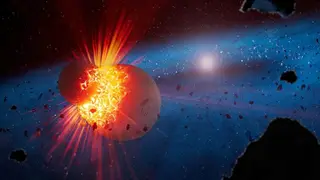
Using the James Webb Space Telescope, astronomers analyzed dust composition in debris disks around young stars to identify evidence of planetary collisions similar to the giant impact believed to have created Earth's Moon. The research team identified minerals in extreme debris disks that correlate with collision intensity: silica-rich dust suggests Mars-sized bodies colliding with enough force to vaporize rock, while silica-poor minerals indicate lower-energy encounters between smaller bodies. This compositional analysis provides indirect evidence for planetary collision events that astronomers cannot observe directly due to the vast distances involved.
The research builds on decades of astronomical work examining stellar systems in their youth. Webb's advanced infrared capabilities enable scientists to detect and classify dust particles around distant stars with unprecedented precision, revealing compositional details that ground-based observations cannot achieve. This technological advancement transforms how researchers approach questions about planetary formation and collision history across the galaxy.
The findings suggest that collision intensity leaves measurable signatures in debris composition. High-velocity impacts between massive planetary bodies generate extreme temperatures that alter mineral structure, while gentler encounters preserve different material properties. By cataloging these compositional patterns across multiple star systems, astronomers develop a framework for understanding whether planetary impacts are common features of stellar system development.
The research may inform long-term perspectives on planetary system formation and stability. Better understanding collision patterns around distant stars could refine models of how Earth and other planets developed, potentially affecting theoretical frameworks in planetary science education and research. The work also demonstrates how space telescope technology translates into concrete scientific knowledge, which could influence funding and policy discussions around future astronomical missions and instrumentation.