Saudi Arabia and UAE Drive Middle East Battery Storage Growth
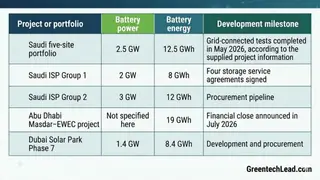
Middle Eastern battery storage is expanding through standalone projects and solar-integrated developments. Saudi Arabia is advancing a 2.5 GW/12.5 GWh five-site portfolio and a 5 GW/20 GWh independent storage procurement pipeline, while the UAE has a 19 GWh solar-linked project in Abu Dhabi and an 8.4 GWh planned system in Dubai. The article notes that operating assets, signed agreements, and procurement pipelines should be assessed separately when measuring grid-ready capacity.
Saudi Arabia’s five-site battery portfolio is spread across Riyadh, Rabigh, Dawadmi, Jouf and Qassim. Its 2.5 GW/12.5 GWh rating implies roughly five hours of discharge at nominal power. Testing reportedly included grid-connected charging and discharging in May 2026, with Alfanar as EPC contractor, BYD supplying batteries, and NR Electric providing grid-forming controls and over 2,000 converters. Uses include load shifting, frequency and voltage support, and black-start capability.
The kingdom’s first ISP group covers four 500 MW/2,000 MWh sites—Al Muwyah, Haden, Al Kahafa and Al Khushaybi—totaling 2 GW/8 GWh. Agreements announced August 20, 2026 exceeded SAR4.35 billion (about $1.16 billion). A second group adds six projects at 3 GW/12 GWh, forming a 5 GW/20 GWh procurement pipeline. Abu Dhabi’s Masdar–EWEC project pairs 5.2 GW solar with 19 GWh storage, targeting 1 GW continuous output from 2027 after July 2026 financial close.
Count? First paragraph: Saudi Arabia’s (1?) Let's count. "Saudi Arabia’s five-site battery portfolio is spread across Riyadh, Rabigh, Dawadmi, Jouf and Qassim." 14? "Its 2.5 GW/12.5 GWh rating implies roughly five hours of discharge at nominal power." 14. "Testing reportedly included grid-connected charging and discharging in May 2026, with Alfanar as EPC contractor, BYD supplying batteries, and NR Electric providing grid-forming controls and over 2,000 converters." 27. "Uses include load shifting, frequency and voltage support, and black-start cap