US Battery Storage Capacity Reaches 52 GW with 54 GW More Planned Through 2028
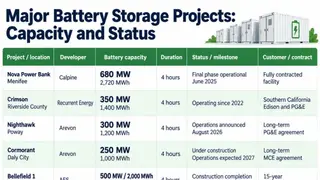
The United States had nearly 52 GW of utility-scale battery storage operating by mid-2026 after adding 8.3 GW in the first half, with developers reporting plans for another 54 GW through 2028 across standalone facilities and solar-plus-storage configurations. Major projects like Nova Power Bank's 680 MW facility and the 350 MW Crimson Storage system demonstrate diverse approaches including facility reuse on former power plant sites and various utility and corporate contract models. California leads deployment activity, with projects serving evening peak demand and participating in wholesale energy and ancillary service markets.
The US battery storage sector is experiencing rapid scaling, with deployments nearly doubling planned capacity additions over the next two years. Projects are increasingly leveraging underutilized industrial sites—particularly retired power generation facilities—to accelerate development timelines and optimize infrastructure investments. This adaptive reuse strategy demonstrates how energy transition infrastructure can occupy existing footprints while serving grid modernization goals.
Battery facilities are structuring revenue streams across multiple customer types simultaneously. Individual projects negotiate separate long-term agreements with utilities for capacity assurance while simultaneously participating in competitive wholesale markets, maximizing asset utilization. This stacked-service approach reflects how storage economics now support complex commercial arrangements rather than single-purpose procurement models.
Expanding battery storage capacity may enhance grid flexibility and renewable energy integration by providing evening supply during peak demand periods. Utilities and corporate purchasers could benefit from improved reliability and cost-predictability through long-term contracts. However, achieving the planned 54 GW by 2028 may depend on sustained financing availability, supply chain stability, and electricity market structures that adequately compensate storage services—factors that remain subject to policy and economic conditions beyond developer control.