Four-Hour Batteries Become Cheaper Than Gas Peakers in Most Modeled Markets
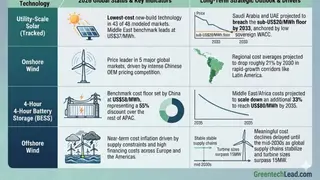
Wood Mackenzie’s 2026 analysis found that four-hour battery storage costs less than open-cycle gas turbines across all 43 markets where both were compared. The shift is linked to expanding battery production, constrained gas turbine supply, and volatile fuel prices. However, US construction-cost data still show gas combustion turbines at a lower upfront cost per kilowatt than battery storage, so lifetime economics and initial investment can diverge.
Wood Mackenzie's 2026 study modeled four-hour batteries and open-cycle gas turbines in 43 markets, with storage cheaper in every one. It credits expanding battery manufacturing, tight turbine supply and volatile fuel prices. In the Middle East and Africa, storage costs are projected to fall 33% to $80/MWh by 2035; China's benchmark is over 55% below the rest of Asia Pacific.
Upfront costs differ. EIA data for equipment installed in 2024 show gas combustion turbines at $841/kW versus $1,469/kW for batteries — historical averages, not current quotes or duration-matched. Charging matters too: at 85% round-trip efficiency, delivering 100 MWh requires about 117.6 MWh of input.
Cheaper four-hour storage could shift how grid operators and developers plan peaking capacity, potentially lowering costs for ratepayers where batteries displace gas. Regions with strong solar output and cheap midday power may benefit most, since charging economics improve. Gas plant owners and fuel suppliers could see reduced demand for peaking services, while battery manufacturers and charging-power providers may gain. Outcomes remain uncertain, though: fuel prices, financing costs and local grid needs vary, and batteries cannot cover extended shortages.