Solar and Batteries Strengthen Cost Lead Over Gas Peaking Worldwide
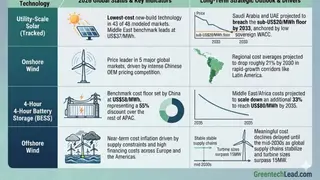
A Wood Mackenzie LCOE study found four-hour battery storage is cheaper than open-cycle gas turbines in every one of the 43 markets modeled. Single-axis tracker solar ranks as the lowest-cost new-build generation source in 43 of 48 markets, with onshore wind leading the other five. In the Middle East and Africa, solar averages $37/MWh in 2026 and could fall to $24/MWh by 2035, while four-hour storage may decline from $120/MWh to $80/MWh over the same period.
Wood Mackenzie's 2026 assessment models 43 markets where four-hour batteries and open-cycle gas turbines compete; storage is cheaper in each. Solar with single-axis trackers is the least expensive new-build option in 43 of 48 markets, while onshore wind leads five. In Middle East and Africa, tracker solar averages $37/MWh in 2026 and may reach $24/MWh by 2035; four-hour storage could drop from $120 to $80/MWh.
China's utility-scale battery costs are more than 55% below the $134/MWh average elsewhere in Asia-Pacific, helped by localized supply chains and production volume. Storage in Asia-Pacific excluding China may average $92/MWh by 2036. Latin America onshore wind could fall from $73 to $58/MWh by 2030.
Cheaper solar, wind, and batteries could affect electricity consumers, grid operators, and investors by making new generation and evening storage more affordable in many markets. Lower storage costs may improve reliability as variable renewables expand, while gas peaking operators could face weaker investment incentives. Regions with strong resources or manufacturing, such as the Middle East, China, and parts of Latin America, may attract more clean-energy projects, though local grid readiness, financing, and policy design will shape who benefits.