BYD Outpaces Tesla in BEV Deliveries as Competition Broadens Beyond Volume
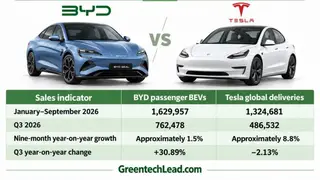
BYD sold 1,629,957 passenger battery-electric vehicles in the first nine months of 2026, compared with 1,324,681 Tesla deliveries, giving it a lead of about 305,000 vehicles. Tesla’s third-quarter deliveries were heavily concentrated in the Model 3 and Model Y, which accounted for roughly 98% of its volume. The rivalry now also involves battery costs, overseas manufacturing, charging access, and recurring software revenue, with the IEA projecting 23 million electric-car sales globally in 2026.
Through September 2026, BYD's fully electric passenger car sales reached 1,629,957, while Tesla delivered 1,324,681 vehicles worldwide. That gap of 305,276 equals roughly 23%. BYD's third-quarter advantage of 275,946 supplied most of this cumulative margin, helped by a 36.87% sequential rise in quarterly passenger BEV sales.
Tesla's third-quarter mix stayed narrow: Model 3 and Model Y made up 478,237 of 486,532 deliveries, about 98.3%. The IEA expects 23 million electric-car sales globally in 2026, or 28% of all car sales, counting both fully electric and plug-in hybrid models. Competition also spans battery expenses, foreign production, charging availability, and software subscriptions.
BYD's volume lead and Tesla's software/charging focus could affect car buyers, manufacturers, workers, and charging providers. Greater competition may pressure prices, potentially widening access to electric vehicles, while also squeezing margins and reshaping factory and supply-chain jobs. Drivers may benefit from more model choices and charging options, though software fees and infrastructure availability could influence total ownership costs. Faster EV adoption may reduce tailpipe emissions where electricity generation is clean, but the scale of that effect depends on grid mix, affordability, and how quickly charging networks expand.