Ancient Capybara Tooth Found in Atacama Desert
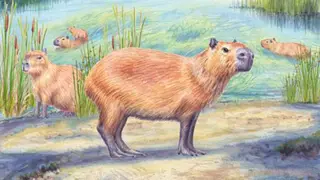
Researchers identified a fossilized molar from an extinct relative of modern capybaras in northern Chile's Atacama Desert. The tooth is about 9 million years old, and capybaras today depend on stable freshwater and water-rich plants. The discovery supports the view that the Atacama was not continuously hyperarid over the past 40 million years.
The fossil is a molar from an extinct capybara relative, recovered in northern Chile’s Atacama Desert. Its age is roughly 9 million years. Modern capybaras, the largest living rodents, require dependable freshwater and eat plants that need ample water. Their absence from Chile today makes the find especially notable.
The tooth came from sediments preserving a shallow marine setting dated to about 7–10 million years ago. Microscopic plant remains there indicate palms, grasses, gingers, and other flowering plants. Together with earlier traces of crocodiles and freshwater fish, this points to a wetter late Miocene landscape, challenging the idea that the region was hyperarid continuously for 40 million years.
This find could shape how scientists and the public interpret long-term climate shifts in arid regions. It may encourage further fossil and geological work in northern Chile, potentially drawing research funding, tourism, or educational interest. Local communities and museums might see modest benefits if the discovery becomes part of regional science outreach. More broadly, it may remind audiences that today’s deserts can have complex wetter histories, though one tooth alone cannot predict future climate conditions.