New Jurassic Croc Relative Boasted Extremely Slender Teeth
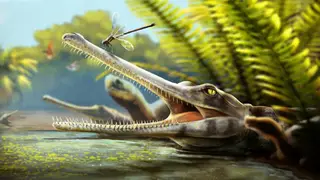
Paleontologists have named a new genus and species, Ctenosuchus tenuidens, from two partial fossils collected in eastern Morocco. This Middle Jurassic thalattosuchian lived about 165 million years ago and had unusually thin, needle-like teeth that were roughly ten times taller than wide and spaced about 2.3 mm apart. Its distinctive dentition suggests it fed on small aquatic prey and differs from that of any other known crocodile-line animal.
Two incomplete fossils from red mudstone near Talsint, in Morocco’s Figuig province, underpin the description. Ctenosuchus tenuidens is placed in Teleosauridae, a thalattosuchian branch of largely marine crocodylomorphs spanning the Early Jurassic to Early Cretaceous. No other freshwater teleosauroid has been recorded from Gondwana, and it is Morocco’s second Jurassic teleosaur.
Its upper jaw carried more than 35 teeth per side, each about ten times taller than wide and set roughly 2.3 mm apart. By contrast, the Indian gharial’s upper-jaw teeth are spaced about 15 mm apart. Researchers think it likely hunted small, soft aquatic prey, including tiny fish, crustaceans, and soft-bodied invertebrates, though a filter-feeding idea remains tentative.
The discovery may draw public attention to Morocco’s Jurassic fossil heritage and to the role of commercial collectors in supplying specimens. Museums, educators, and paleontology enthusiasts could use it to illustrate crocodile-line diversity and feeding adaptations. It may also encourage further fieldwork and local scientific collaboration, though its broader societal impact is likely modest and mainly within science communication and heritage sectors.