Jurassic Mammaliaform Fossil Reveals Early Mammal-Style Swallowing Anatomy
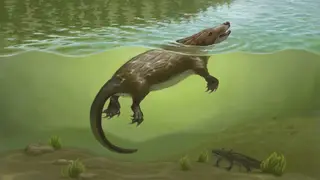
Researchers describe Megacauda sungei, a roughly platypus-sized docodont from about 165 million years ago that lived in what is now Inner Mongolia and likely swam for food. Exceptionally preserved throat bones indicate it had a mammal-like swallowing apparatus, including a complex hyoid and soft palate, similar to living marsupials and placentals. The find suggests key feeding adaptations for suckling and drinking appeared before modern mammals and adds to evidence that early mammaliaforms were ecologically diverse.
Megacauda sungei, a docodont mammaliaform from roughly 165 million years ago, is the largest Jurassic mammaliaform yet known, measuring about half a meter and weighing one to two kilograms — far bigger than most contemporaries, which were only grams. Its flattened tail, short hind limbs with long feet, and shearing teeth point to a semiaquatic life, possibly burrowing on land and hunting fish, salamanders, and invertebrates in water.
Preserved pharynx and throat bones reveal a hyoid and soft palate arrangement resembling that of living marsupials and placentals. This suggests mammal-style swallowing, drinking, and suckling arose before modern mammals, in the shared ancestors of docodonts and therians.
Findings like this could shape how paleontologists and science communicators frame early mammal evolution, potentially shifting public perception of Mesozoic life away from dinosaur-only narratives. Museum exhibits and educational materials may eventually incorporate such reconstructions, influencing how students and visitors understand mammalian origins. For researchers, the work may prompt renewed scrutiny of throat anatomy in other fossils, though its broader societal reach likely remains indirect and gradual.