Astronomers Pin Down the Farthest Known Radio Burst’s Home Galaxy
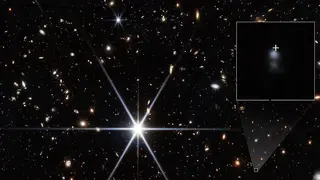
A radio flash from more than 10 billion light-years away has been linked to a small host galaxy, setting a distance record for such events with identified origins. The signal, FRB 20240304B, was detected by the MeerKAT telescope and later traced with JWST to a faint galaxy seen as it existed about 10.6 billion years ago. Astronomers say the measurement could help probe the diffuse matter between galaxies.
Astronomers detected FRB 20240304B with South Africa’s MeerKAT telescope through the MeerTRAP project. Because charged material in space slows some radio frequencies more than others, the signal’s dispersion helped estimate its vast distance and sky position.
Follow-up with JWST’s near-infrared camera found a faint host galaxy. Its light indicates the burst came from a small, metal-poor galaxy undergoing intense star formation, seen about 10.6 billion years ago, when the universe was roughly three billion years old. This host is far smaller than the Milky Way.
This record could sharpen efforts to map diffuse intergalactic matter, giving cosmologists a new probe of the universe’s hidden gas. It may also strengthen public interest in space science and support observatories and data tools that enable such discoveries. Because FRBs remain unpredictable, any practical benefits would likely be indirect and long-term, emerging through improved understanding rather than immediate applications.