Hera Spacecraft Prepares for November Rendezvous with Didymos and Dimorphos
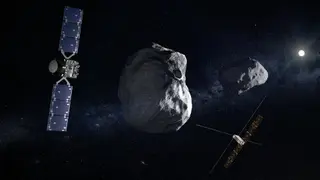
ESA's Hera mission is approaching the binary asteroid system Didymos and Dimorphos after launching in October 2024. It will follow up on NASA's DART impact, which struck Dimorphos in 2022 and changed its orbit around Didymos. Hera is expected to arrive in November and provide detailed observations of the aftermath.
Hera launched on 7 October 2024 aboard a Falcon 9 from Cape Canaveral and has spent just over two years cruising toward the Didymos system. ESA classifies it as the first mission under its Space Safety Programme, and it is closing on the pair at about 12 kilometers per second relative to Earth.
Didymos, discovered in 1996, is roughly 780 meters wide and spins every 2.2 hours. Its moonlet Dimorphos, about 151 meters across, was found in 2003. DART’s 2022 strike shortened Dimorphos’s orbit by roughly 32 minutes. Hera carries two CubeSats, Juventas and Milani, for close-up studies.
Hera’s follow-up observations could sharpen understanding of asteroid deflection, informing future planetary-defense planning. Scientists, engineers, and space agencies may benefit from data on Dimorphos’s altered shape, orbit, and debris. The public could gain a clearer sense of how humanity might respond to a hazardous near-Earth object, though this mission alone cannot guarantee protection. Commercial and academic teams involved in CubeSat technology may also see lessons for small, autonomous spacecraft.