Webb telescope maps organized weather on a nearby brown dwarf
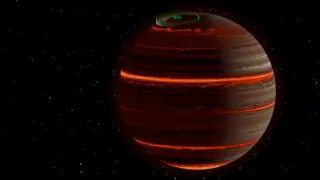
Using NASA’s James Webb Space Telescope, researchers examined the brown dwarf SIMP 0136 and found that its atmospheric variations are largely controlled by temperature changes and the vertical arrangement of clouds. The team applied principal component analysis to separate real weather patterns from noise in the telescope data. The method could help astronomers study atmospheric conditions on planets and other distant worlds.
SIMP 0136 lies about 20 light-years away and sits between planets and stars: bigger and warmer than a typical gas giant, yet too low-mass to shine like a star. Its huge cloud systems shift quickly, making its weather resemble an extreme version of Jupiter’s.
Using Webb data, researchers applied principal component analysis to isolate meaningful atmospheric changes from noise. They found two dominant factors—temperature shifts and the vertical layout of clouds—and three repeating weather states that rotate into and out of view. Hotter regions have thinner clouds; cooler ones have thicker, vertically extended cloud layers.
This research may mainly affect astronomers and space-science communities by offering a method to interpret faint atmospheric signals from distant worlds. It could improve how scientists compare brown dwarfs, distant planets, and planetary weather, potentially enriching public understanding of planetary science. Broader society may benefit indirectly through educational content, instrument-development incentives, and inspiration for STEM fields, though near-term practical applications are uncertain.