Ancient Moroccan Wall Reveals Unexpected Sophistication of Prehistoric North African Societies
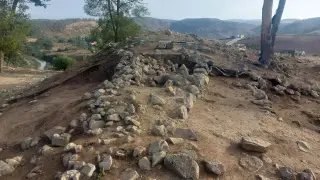
Archaeologists have uncovered a 4,000-year-old defensive structure in northwest Morocco, challenging previous assumptions about the complexity of early North African civilizations. The discovery at Oued Beht indicates organized construction and social coordination during the second millennium BC, suggesting greater regional influence in Mediterranean history than previously believed. The site also shows repeated use across different eras, including the medieval period.
In northwest Morocco’s Oued Beht region, archaeologists have uncovered a 4,000-year-old defensive wall system dating to the second millennium BC, making it the earliest confirmed large-scale fortification in North Africa outside the Nile Valley. The structure, built across a narrow ridge between a river and ravine, features a multi-phase ditch, rampart, and wall that protected the southern tip of the site. Radiocarbon dating places its initial construction between 2500–2000 BCE, aligning with the Bronze Age in neighboring Mediterranean regions. The discovery was made during renewed excavations by the Oued Beht Archaeological Project (OBAP), building on earlier findings from the 1930s by French archaeologist Armand Ruhlmann, who first noted a configuration of three walls and a natural scarp forming an *éperon barré*. The site had previously revealed one of Africa’s earliest and largest agricultural complexes, dating to 5,400–4,900 years ago, indicating long-term human occupation. New excavations in 2023 confirmed the defensive nature of the structure, suggesting organized labor and social coordination far earlier than previously assumed for the Maghreb. The site also saw renewed use during the medieval period (11th–13th centuries AD), when it was rebuilt and used as a settlement and burial ground, showing enduring strategic importance.
The findings challenge long-standing assumptions that prehistoric North African societies were isolated or less complex than those in Europe
The discovery at Oued Beht could reshape how scholars and educators view prehistoric North Africa, shifting it from a peripheral region to a center of early social complexity. This may influence museum exhibitions, academic curricula, and public understanding of African contributions to Mediterranean history—particularly in regions where colonial-era narratives minimized indigenous innovation. The site’s dual use across millennia suggests long-term cultural continuity, which could inform heritage policies in Morocco and neighboring countries seeking to strengthen national identity through archaeology. Comparable to the recent reevaluation of Göbekli Tepe in Turkey, which challenged assumptions about Neolithic societal development, Oued Beht may prompt similar reassessments elsewhere in Africa. If further evidence confirms regional networks, it could affect how trade routes and cultural diffusion are modeled across the Mediterranean. Researchers may now look more closely at other underv