Can Black Holes Split? Theoretical Study Explores Rare Cosmic Event
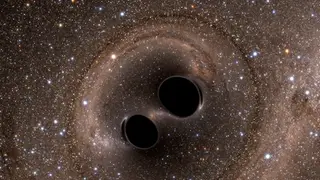
A new theoretical study from the University of Southern Denmark suggests that under extreme conditions—particularly rapid rotation—a black hole could potentially split into smaller ones. This would contradict the common view that black holes only merge, not divide. Such a process remains highly speculative and would require very specific physical parameters.
A theoretical study led by researchers at the University of Southern Denmark, published in Physical Review D on October 22, 2026, explores the possibility that black holes could split under extreme conditions—specifically, when rotating near their maximum possible rate. The work, co-authored by Francesco Sannino from the University of Naples Federico II and the Quantum Field Theory Center at SDU, challenges the long-held assumption that black holes only merge, never divide. The study uses the concept of “pair-of-pants topology” to model how a single black hole might branch into two or more smaller ones, but only if rotational energy overcomes thermodynamic barriers. Crucially, such a split would require the resulting black holes to move apart rather than recombine, which limits the scenario to only the most rapidly spinning objects. The research builds on prior understanding of entropy and the second law of thermodynamics, which generally prohibit a system from decreasing total entropy in a spontaneous process—making splitting unlikely for non-rotating or slowly rotating black holes.
The background stems from decades of observational evidence showing black hole mergers via gravitational wave detections (e.g., LIGO/Virgo), reinforcing the idea that black holes grow through collisions. However, this study opens a speculative path toward reversal mechanisms under exotic conditions. While no empirical evidence supports splitting yet, the work invites reconsideration of black hol
This theoretical exploration could influence how physicists model black hole evolution in extreme environments, such as near galactic centers or during early universe conditions. While unlikely to impact public perception directly, it may inspire new observational strategies—such as refining gravitational wave data analysis to detect anomalies that might hint at non-merger processes. Institutions like LIGO and future space-based detectors (e.g., LISA) could eventually incorporate such models into their search algorithms, though no immediate changes are expected. A comparable precedent is the 2015 detection of gravitational waves from a black hole merger—once theoretical, now foundational to astrophysics. This study may similarly serve as a catalyst for re-examining long-standing assumptions, even if not immediately testable. What to watch for next is whether additional theoretical frameworks or observational anomalies prompt deeper investigation into black hole stability under rotation