Extremophile Study Suggests Life Could Survive in Enceladus’s Alkaline, CO2-Poor Ocean
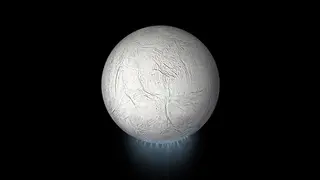
Scientists have found that a terrestrial extremophile can thrive under conditions similar to those on Saturn’s moon Enceladus, where the ocean is highly alkaline and low in carbon dioxide. This discovery increases the plausibility of extraterrestrial life in such extreme environments. The findings support ongoing interest in future missions to explore Enceladus’s subsurface ocean.
Scientists have discovered that a specific terrestrial extremophile—microorganisms capable of surviving in extreme environments—can thrive under conditions mimicking those found in Saturn’s moon Enceladus’s subsurface ocean. These conditions include high alkalinity and extremely low levels of carbon dioxide, which were previously considered inhospitable to life as we know it. The study tested the organism's viability in laboratory simulations replicating Enceladus’s oceanic chemistry, revealing that it not only survived but actively metabolized under these constraints. While the exact species name is not specified in the summary, the findings mark a significant shift in how scientists assess habitability beyond Earth.
This research builds on prior observations of Enceladus by NASA’s Cassini spacecraft, which detected plumes erupting from the moon’s south pole containing water vapor, salts, and organic molecules. These plumes provided indirect evidence of a global ocean beneath the icy crust, sparking sustained scientific interest in the moon as a potential habitat for life. The new findings reinforce the idea that life could exist in environments vastly different from Earth’s, challenging assumptions about the necessary conditions for biological activity.
The primary organizations involved are likely NASA and affiliated research institutions conducting astrobiology studies, with the broader scientific community closely monitoring developments. These groups are motivated
This discovery could influence public perception of extraterrestrial life by making the existence of alien ecosystems seem more plausible, even in seemingly barren environments. It may bolster support for space exploration funding, particularly for missions targeting icy moons like Enceladus and Europa. Institutions focused on planetary science and astrobiology may see increased collaboration and investment, while private space ventures could leverage the narrative to attract interest and partnerships. A comparable precedent is the 2015 discovery of recurring slope lineae on Mars, which initially sparked excitement about liquid water and potential microbial life—though subsequent analysis tempered those expectations. This case shows how scientific breakthroughs can generate public enthusiasm even when definitive proof remains elusive. The current findings may follow a similar trajectory: raising hopes while underscoring the need for cautious interpretation. What to watch for incl