Hidden Eyes Discovered in Daddy Longlegs Reveal Ancient Evolutionary Legacy
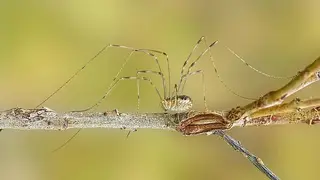
Scientists uncovered two additional pairs of vestigial eyes in daddy longlegs, remnants of an ancient visual system shared with insects and other arthropods. These eyes are not functional but are confirmed through the presence of light-sensitive opsins in embryonic stages. The discovery offers new insight into the evolutionary history of arachnids.
In November 2026, scientists Guilherme Gainett and Prashant Sharma from the University of Wisconsin-Madison reported the discovery of two additional pairs of vestigial eyes in daddy longlegs (Opiliones), specifically in the species *Phalangium opilio*. These hidden eyes, revealed through embryonic gene expression studies, were not functional in adult specimens but showed activity of light-sensitive opsins during early development. The findings, published in *Molecular Biology and Evolution* in August 2026, built on earlier work from a 2014 fossil study that had hinted at lateral eye structures in ancient arachnids. The research team used gene suppression techniques targeting the *eyeless* and *twin of eyeless* genes—part of the Pax6 family known to regulate eye development across animals—and found that simultaneous disruption caused developmental anomalies, suggesting these genes were once crucial for forming multiple eye pairs. This supports the idea that daddy longlegs evolved from ancestors with more complex visual systems shared with insects and other arthropods.
The background lies in longstanding questions about arachnid evolution: while spiders have eight eyes, most modern daddy longlegs only have two median eyes, raising questions about their evolutionary trajectory. The discovery of vestigial eye structures—particularly the lateral and anterior median pairs—offers a genetic and developmental explanation for this reduction. Gainett, now at Harvard Medical School, d
This discovery could influence how evolutionary biology textbooks frame sensory system evolution, particularly in arthropods. By revealing deep genetic continuity between insects and arachnids through vestigial eyes, it reinforces the idea that major morphological changes often involve the silencing of ancient developmental programs rather than entirely new innovations. The finding may also affect comparative genomics research, encouraging deeper scrutiny of gene regulatory networks in non-model organisms. Institutions focused on evolutionary development (evo-devo) may prioritize similar studies in other long-lived arthropod groups. A comparable case is the discovery of vestigial hind limbs in whales—once a controversial idea, now foundational in understanding vertebrate evolution. Here, the impact may be more subtle but no less significant: it could shift how scientists interpret "missing" traits in evolutionary lineages. What to watch for next includes whether similar opsin expressio