Hubble Captures a Star Ejected from the Tarantula Nebula at High Speed
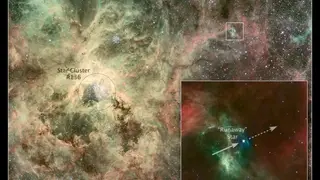
Astronomers using the Hubble Space Telescope have identified a runaway star that appears to have been ejected from the Tarantula Nebula, a massive star-forming region in the Large Magellanic Cloud. The star’s unusual trajectory and high velocity suggest it was likely flung out due to a dynamical interaction, possibly involving a binary star system disruption. Such events help scientists understand stellar dynamics and the violent processes that shape star clusters.
Astronomers using the Hubble Space Telescope have identified a high-velocity star ejected from the Tarantula Nebula, a massive star-forming region within the Large Magellanic Cloud, one of our galaxy’s closest satellite galaxies. The star, observed in an image captured by Hubble’s Advanced Camera for Surveys, exhibits an unusual trajectory and speed that suggest it was violently expelled—likely due to a dynamical interaction such as a close encounter between binary star systems or a supernova explosion in a multiple-star system. While the exact mechanism remains uncertain, the event is consistent with known processes that produce runaway stars: stars moving at speeds far exceeding the average motion of their stellar environment. The Tarantula Nebula, also known as 30 Doradus, is renowned for hosting some of the most massive and luminous stars in the local universe, making it a prime location to study extreme stellar dynamics. This discovery builds on earlier work identifying other runaway stars like GD 50, AE Aurigae, 53 Arietis, and Mu Columbae—stars whose motions trace back to the Orion Nebula region around two million years ago, possibly due to a supernova event. The presence of Barnard’s Loop, a large gas bubble surrounding Orion’s Belt, supports this hypothesis.
The research team, led by scientists at NASA and collaborating institutions using Hubble data, aims to understand how such violent interactions shape star clusters and influence galactic evolution. By tracing the paths of runaway stars backward in time, astronomers can reconstruct past stellar encounters and test models of star cluster dynamics. The specific identity of the newly discovered Tarantula Nebula runaway star is not named in the article, nor is its exact velocity or age specified. What remains unresolved is whether this ejection was due to a binary disruption or a supernova, and how common such events are in dense star-forming regions. Future observations may help pinpoint the origin more precisely and determine if similar ejections are frequent in other nebulae.
The discovery of a runaway star from the Tarantula Nebula could influence public understanding of stellar violence and cosmic dynamics, reinforcing the idea that space is not static but shaped by explosive events. While such findings may not directly impact technology or markets, they contribute to science literacy and inspire interest in astronomy among students and amateur stargazers. The story’s emphasis on Hubble’s role highlights the enduring value of long-term space observatory missions, potentially influencing public support for future telescopes like the James Webb Space Telescope. Comparable cases include the 2009 identification of GD 50 as a Pleiades-born star flung outward—demonstrating how historical data and motion tracking can reveal past cosmic events. This precedent suggests that similar analyses may uncover more hidden stellar histories in other clusters. What to watch for next is whether follow-up studies using advanced instruments will detect additional runaway stars in the Large Magellanic Cloud, potentially revealing patterns in star cluster disruption. Such findings could refine models of galactic evolution and inform how we interpret the distribution of stars across galaxies.