Putin Travels to China with Nuclear Command Device Cheget
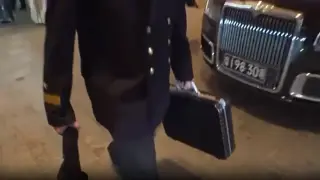
Russian President Vladimir Putin was accompanied by an aide carrying the Cheget nuclear command briefcase during his visit to China for the APEC summit. The device, developed during the Soviet era, allows the president to access secure military communications and authorize nuclear weapons. This is not the first time Cheget has been seen with Putin, having previously appeared during his 2023 visit to Beijing.
On November 18, 2026, Russian President Vladimir Putin was seen in Shenzhen, China, during the APEC summit, accompanied by an aide carrying the Cheget nuclear command briefcase—a device developed during the Soviet era and named after a mountain in the Caucasus. The case, identified by Russian media and reported by APA, is part of Russia’s nuclear command-and-control system, enabling secure communication and authorization for nuclear weapons during travel. This is not the first time Cheget has been publicly observed with Putin; it was previously seen during his October 2023 visit to Beijing, when two uniformed naval officers carried similar cases. Historical records show the briefcase has been a fixture in presidential transitions, notably when Putin received it from Boris Yeltsin in 1999 and later from Dmitry Medvedev in 2012. The device’s presence underscores the continuity of Russia’s nuclear command protocols, even amid high-level diplomatic engagements. While the US Naval Postgraduate School describes Cheget as a tool for preparing and issuing nuclear launch authorizations, the exact operational configuration remains classified. No change in Russia’s nuclear alert status was reported, and the case was not linked to any immediate crisis. The upcoming three-way talks between Putin, Donald Trump, and Xi Jinping in Shenzhen may include nuclear arms control, though the significance of Cheget’s presence remains symbolic rather than operational.
The public display of the Cheget briefcase during a high-profile international summit could amplify global anxiety about nuclear readiness, particularly amid ongoing tensions in Eastern Europe and the Middle East. While the device is a standard part of Russia’s nuclear command infrastructure, its visibility may be interpreted as a signal of strategic posture—potentially intended to underscore Russia’s nuclear deterrence capabilities during diplomatic negotiations. The recurrence of such imagery, especially in the context of talks involving the U.S. and China, may influence perceptions of Russian power projection and diplomatic leverage. Comparable moments include the 2014 annexation of Crimea, when similar displays of military hardware were used to signal resolve. However, unlike those instances, this event lacks direct military escalation, suggesting a more calculated, symbolic use of nuclear symbolism. The broader impact may be on international security discourse, potentially affecting arms control negotiations or influencing public opinion in allied nations. What remains unclear is whether the briefcase’s presence reflects routine protocol or a deliberate message—something that could shape future diplomatic engagement, especially as nuclear risk assessments evolve in response to shifting geopolitical dynamics.