Astronomers Observe Real-Time Stellar Merger in Andromeda Galaxy, Create New Star 'Bao'
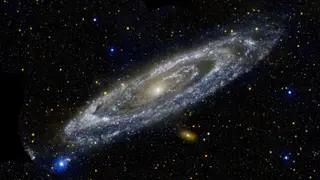
Astronomers have observed the real-time merger of two stars in the Andromeda galaxy, resulting in a new star nicknamed 'Bao.' The event, first detected in 2023 by NASA's NEOWISE mission, involved a Sun-like star merging with a puffy supergiant seven times more massive than the Sun. The James Webb Space Telescope captured data just 47 days after the merger's peak eruption, allowing scientists to study the process before, during, and after the explosion.
In October 2025, astronomers observed the real-time merger of two stars in the Andromeda galaxy, resulting in a new stellar object designated AT 2025abao and nicknamed “Bao.” The event involved a Sun-like star, dubbed “Little Bao,” merging with a massive, puffy supergiant named “Big Bao”—seven times more massive than the Sun, with a radius 350 times that of the Sun and 18,000 times greater luminosity. The merger was first detected in February 2023 by NASA’s NEOWISE mission, which noted increasing infrared brightness and dust ejection from Big Bao. Subsequent observations by the SPHEREx telescope in July 2025 and the Zwicky Transient Facility in October confirmed a luminous eruption. The James Webb Space Telescope captured data just 47 days after the peak eruption, offering a rare, continuous view of the merger’s evolution. This marks the first time a rapid stellar merger—occurring after only seven orbits over about seven years—has been observed in real time, challenging prior assumptions that such events unfold over thousands of orbits. The process is believed to be a case of common envelope evolution, where the smaller star was drawn into the larger one, triggering an internal explosion and ejection of gas. The study, led by Viraj Karambelkar of Columbia University and published in Nature, leverages data from multiple observatories, including Hubble and WINTER, to model the dynamics of the merger and measure the efficiency of mass ejection. The outcome—Bao—now stands as a single star formed from the violent fusion of two distinct stellar bodies.
The broader significance lies in understanding how binary systems evolve, particularly how common envelope phases shape stellar populations. Prior to this observation, such mergers were inferred from theoretical models or detected post-merger via remnants like supernovae or gravitational wave sources. This real-time capture provides empirical validation of long-standing astrophysical theories. The team, including co-author Karel Temmink, aims to refine models of stellar dynamics and mass loss. What remains unresolved is whether Bao will stabilize into a long-lived star or undergo further instability. Future observations may reveal if the system emits detectable gravitational waves or if the ejected material contributes to interstellar dust formation. The exact timeline for Bao’s post-merger evolution is still unknown, and long-term monitoring will be essential.
This discovery could deepen public engagement with astrophysics by offering a vivid, real-time narrative of cosmic violence and creation, potentially influencing science education and media coverage of space. The involvement of major institutions like NASA, ESA, and the James Webb Space Telescope underscores the role of international collaboration in advancing fundamental science, which may strengthen public support for large-scale space missions. The event’s visibility across multiple wavelengths—from infrared to optical—demonstrates the power of multi-mission coordination, possibly shaping future observational strategies for transient phenomena. Comparable to the 2019 detection of a neutron star merger via gravitational waves and electromagnetic signals, this merger offers a new benchmark for multi-messenger astronomy, though without gravitational wave confirmation. If future observations reveal Bao’s long-term behavior, it may inform models of stellar evolution and the origins of certain types of supernovae or compact objects. Scientists may also reassess how common envelope events contribute to galactic chemical enrichment. The next phase will likely involve continued monitoring to assess Bao’s stability and the dispersal of ejected material, which could influence nearby star formation.