Zelensky Demands Tangible Outcomes in Upcoming Four-Nation Peace Negotiations
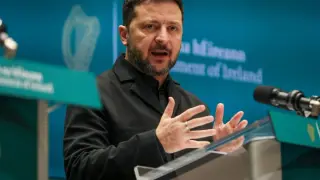
President Volodymyr Zelensky stated during a meeting with British Defense Secretary Wes Streeting on November 21, 2026, that the next round of four-party peace talks involving Ukraine, Europe, Russia, and the United States must produce clear results with defined goals. He welcomed the recent Abu Dhabi agreement to exchange over 1,000 Ukrainian prisoners of war and urged negotiators to pursue an 'all-for-all' prisoner swap and measurable progress toward ending the war.
On November 21, 2026, Ukrainian President Volodymyr Zelensky met with British Defense Secretary Wes Streeting in Kyiv, where he emphasized the need for the upcoming four-party peace negotiation—featuring Ukraine, the United States, Europe, and Russia—to deliver concrete outcomes. The meeting followed the recent Abu Dhabi agreement, finalized on November 10–11, 2026, which facilitated the exchange of over 1,000 Ukrainian prisoners of war. Zelensky welcomed this humanitarian progress but stressed that future talks must go beyond individual exchanges and aim for a comprehensive “all-for-all” prisoner swap. He called for a clearly defined agenda with both minimum and maximum objectives, underscoring the urgency of measurable progress toward ending the war. The next session’s timing hinges on the U.S. coordinating the agenda among all four parties, with Zelensky noting that while Washington seeks swift action, Russia is expected to delay proceedings. The European Union has formalized its representation through the E5 format—France, Germany, the UK, Italy, and Poland—following an informal summit in Dublin on November 13, 2026. Meanwhile, Germany’s Chancellor Friedrich Merz suggested a neutral venue like the UAE for the next round, though uncertainty remains over whether Russia will accept an invitation, especially after reports of a separate Kremlin outreach to Western security advisors.
The push for a structured, results-oriented four-party negotiation could signal a shift from symbolic diplomacy to actionable outcomes, potentially affecting millions of civilians still displaced or detained. If successful, such talks may ease humanitarian suffering and reduce the risk of escalation, particularly if prisoner exchanges become systematic. However, the lack of binding commitments and Russia’s history of stalling tactics suggest that progress may remain fragile. The involvement of the E5 bloc reflects a broader European effort to unify its voice, similar to how NATO coordinated during the Cold War, though without the same enforcement mechanisms. The U.S. role as coordinator may strain transatlantic unity if perceived as favoring one side. What remains uncertain is whether Russia will engage in good faith, especially given its recent military actions in Crimea and eastern Ukraine. The next few weeks will be critical: if the U.S. can align all parties on a shared agenda, the talks could gain momentum. But if delays persist, the window for de-escalation may narrow, potentially reinforcing hardline positions across all sides.