Swedish Pilot Unable to Engage Russian Missile Over Poland Due to Severe Weather
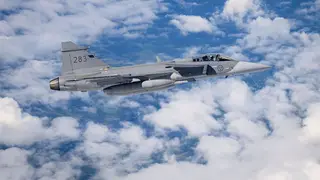
A Swedish Gripen pilot was authorized to intercept a suspected Russian Kh-101 cruise missile over Poland on November 20 but could not engage due to poor weather conditions that prevented visual and electro-optical identification. The incident occurred during a large-scale Russian attack on Ukraine, with three aerial objects entering Polish airspace. NATO is reviewing the response to Russian threats along its eastern flank.
On November 20, 2026, during a major Russian assault on Ukraine, three aerial objects entered Polish airspace, prompting a NATO response. A Swedish JAS 39 Gripen pilot, operating under NATO’s Combined Air Operations Centre in Uedem, Germany, was authorized to intercept a suspected Russian Kh-101 cruise missile but could not engage due to severe weather that blocked visual and electro-optical identification. The incident occurred amid a broader escalation, with Polish forces tracking 11 potentially threatening objects, three of which crossed into national airspace. Two Swedish Gripens, two Polish F-16s, a Saab 340 early warning aircraft, and a Dutch refueling tanker were deployed, supported by ground-based air defenses and intelligence from Ukraine’s Virazh surveillance system. Polish Defense Minister Władysław Kosiniak-Kamysz confirmed that two Russian missiles and a suspected jet-powered drone had fallen on Polish territory, though no injuries were reported. This event follows a precedent set in September 2025, when Polish and Dutch jets shot down Russian drones over Poland—marking the first time NATO forces used force against Russian aerial threats during the full-scale invasion. The incident has prompted NATO to review its eastern flank defense posture, with Secretary General Mark Rutte affirming that NATO would defend every inch of Polish territory. Poland’s Prime Minister Donald Tusk suggested the timing of the incursions may have been a deliberate provocation, coinciding with military exercises involving Ukraine’s European allies. The North Atlantic Council is set to meet in Brussels on November 23 to discuss the event.
The failure to intercept a suspected Russian missile over Poland due to weather may heighten concerns about NATO’s readiness to respond to asymmetric threats in real time, especially when technological and environmental constraints limit engagement. While no casualties occurred, the incident underscores vulnerabilities in air defense systems when weather degrades sensor performance—raising questions about the reliability of current protocols for rapid decision-making under uncertainty. This could influence future military planning, particularly regarding the integration of autonomous systems or enhanced sensor fusion to compensate for human and environmental limitations. Comparable to the 2025 drone shoot-down, which marked a turning point in NATO’s defensive posture, this event may prompt deeper investment in resilient surveillance networks and forward-deployed assets. The broader impact may extend to European defense spending, with allies potentially accelerating commitments to bolster NATO’s Eastern Sentry operation. What remains uncertain is whether this incident will lead to a formal change in engagement rules or trigger a broader strategic reassessment of deterrence in the region. Observers should watch for NATO’s next steps in Brussels and whether the alliance moves toward more proactive or pre-emptive measures in response to Russian aerial activity.