Hubble telescope reaches 200,000 orbits and 5 billion miles
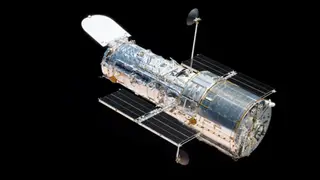
NASA announced that the Hubble Space Telescope completed its 200,000th orbit around Earth on September 19, having traveled over 5 billion miles in 36 years. Hubble has made more than 1.7 million observations, far exceeding its original 15-year design life. Its ultraviolet and visible light capabilities remain in high demand, with astronomers requesting about seven times more observing time than available.
Hubble launched aboard the Space Shuttle Discovery in April 1990, designed to operate for roughly 15 years. It has now far surpassed that benchmark, completing more than 1.7 million observations across its 36-year mission. Its scientific legacy includes measuring the universe's expansion rate, confirming supermassive black holes, and detecting organic molecules in exoplanet atmospheres.
The telescope's current work includes repeated imaging of galaxy cluster MACS J0417, located about 4.65 billion light-years away. Scientists are tracking Supernova Athena, first spotted by the James Webb Space Telescope in 2025. Gravitational lensing from the cluster may cause the supernova to reappear between now and early March 2027, offering a fresh opportunity to measure cosmic expansion.
Hubble's continued operation could shape scientific priorities for years, as its ultraviolet and visible-light observations complement newer instruments like the James Webb Space Telescope. With astronomers requesting roughly seven times more observing time than available, competition for Hubble's use may intensify. Its longevity may also influence how agencies plan future missions, demonstrating that well-maintained orbital instruments can deliver decades of returns, potentially affecting budget decisions and public expectations for space science investments.