Eggshells Show Titanosaurs Nested Near Antarctica in Cretaceous
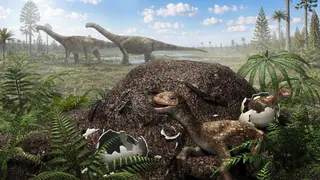
Paleontologists discovered fossilized eggshells in Argentina's Chorrillo Formation, dating to about 70 million years ago, at a paleolatitude of 55-60°S. The eggshells belong to the oogenus Fusioolithus, associated with titanosaurs, making this the southernmost known dinosaur nesting site in the southern hemisphere. The find extends evidence of high-latitude nesting to the south, previously documented mainly in northern polar regions.
Previous evidence of high-latitude dinosaur nesting came chiefly from northern sites in Siberia, Alaska, and Alberta, spanning roughly 57 to 75 degrees north. The Chorrillo Formation find, at 55 to 60 degrees south, now provides a southern counterpart, showing that titanosaurs—among the largest dinosaurs—reproduced in cool, seasonally dark environments.
The eggshells' high porosity suggests the eggs were buried in mound nests, relying on decomposing vegetation for warmth rather than direct sunlight or parental brooding. This incubation strategy parallels that inferred for northern polar dinosaurs, indicating convergent adaptation to challenging high-latitude conditions. Titanosaur bones at the same site strengthen the association between these eggshells and the giant sauropods.
This discovery could reshape public understanding of dinosaur adaptability, showing that even the largest sauropods thrived in polar conditions. For educators and museums, it offers a compelling narrative about reproductive strategies in extreme environments. It may also guide future paleontological exploration in southern high-latitude regions, potentially influencing research priorities and funding. The find underscores how much remains unknown about dinosaur life in the southern hemisphere.