New Studies Suggest Detecting Biosignatures on Enceladus May Be Simpler Than Previously Expected
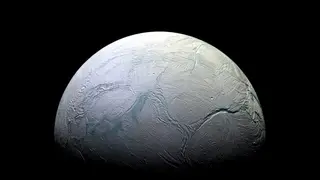
Researchers from Freie Universität Berlin have published two studies indicating that future spacecraft missions to Saturn's moon Enceladus could identify signs of life more readily than anticipated. The studies reveal that ocean droplets escaping through the moon's ice shell freeze more slowly than models predicted, allowing salts and organic compounds to become highly concentrated in ejected ice particles. These findings suggest that biosignatures in Enceladus's plumes could be more detectable through analysis of the moon's characteristic eruptions.
Enceladus has emerged as a prime target for astrobiology research because its subsurface ocean circulates through hydrothermal vents at the core-mantle boundary, creating conditions potentially suitable for microbial life. The moon's southern polar region periodically ejects enormous plumes of water and ice particles into space, which spacecraft have already sampled and analyzed for chemical signatures associated with life.
The Berlin research team's findings address a fundamental challenge in detection: as ocean water freezes while traveling upward through the moon's crust, dissolved materials like salts and organic compounds concentrate in specific locations within the ice particles. This concentration effect means that any biological markers present would appear in higher densities, improving the likelihood that instruments aboard passing spacecraft could identify them.
These findings could reshape priorities for future planetary exploration funding and mission design. Space agencies may gain confidence to proceed with expensive dedicated Enceladus missions, potentially accelerating timelines for astrobiology research. The results could also influence how instruments are configured aboard upcoming missions, with designers potentially optimizing detection thresholds for concentrated biomarkers rather than dispersed ones. Public interest in extraterrestrial life discovery may intensify as feasibility appears to improve.