Global Offshore Wind Leadership: Five Nations Control 90 Percent of Capacity as UK Emerges as Major Construction Hub
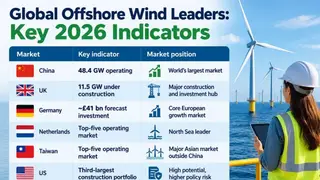
Five countries—China, the United Kingdom, Germany, the Netherlands, and Taiwan—account for 90.3 percent of global offshore wind capacity as of end-2025, with China alone commanding 48.4 GW and leading eight consecutive years of annual installations. The UK has emerged as a major construction market outside China with 11.5 GW under construction by mid-2026, while Poland, France, South Korea, and Japan position themselves for expansion in the next growth phase. More than 50 GW remains under construction globally, signaling the industry's continued geographic concentration and shifting investment patterns.
The offshore wind sector demonstrates stark geographic concentration, with just five nations controlling over 90 percent of installed capacity. China's dominance extends beyond raw numbers—the country has built an integrated supply chain encompassing turbine manufacturing, component production, and specialized installation infrastructure. This vertical integration enables rapid deployment and technological advancement, as evidenced by China's recent deployment of 20 MW turbines while the global average reached 10.3 MW in 2025.
The UK's emergence as a construction powerhouse reflects different market dynamics. Rather than operating capacity, the UK's significance lies in its development pipeline and investment commitments. With over £100 billion in projected spending across 91.4 GW of planned projects, the UK represents the industry's expansion beyond Asia-Pacific markets. Government support through long-term contracts and competitive auctions provides revenue certainty that attracts private capital, establishing conditions for sustained growth.
Offshore wind's geographic concentration could influence global energy security and climate strategy. Nations with established capacity like China, the UK, and Germany may shape technology standards and supply chains, potentially affecting deployment timelines elsewhere. Emerging markets positioning for expansion—Poland, France, South Korea, and Japan—could diversify manufacturing and reduce dependency on concentrated supply sources. The industry's capital intensity may advantage wealthy nations, potentially widening energy transition disparities while creating employment concentrated in specific regions.