EU Industrial Accelerator Act Must Revive Europe's Stalled Battery Manufacturing Sector
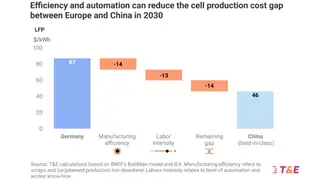
Europe's battery production capacity has suffered significant setbacks, with roughly a quarter of announced projects since 2022 cancelled or shelved, particularly affecting Germany's pipeline. However, current EU cell production can meet demand for corporate electric vehicles by 2027, and the Industrial Accelerator Act incentives are both necessary and achievable to materialize and scale battery projects across the continent. Transport & Environment analysis refutes industry claims of a battery gap, finding that methodological flaws led to overly pessimistic conclusions about European battery cell capacity and onshoring costs.
Europe's battery manufacturing ambitions face a credibility challenge after Transport & Environment identified significant flaws in industry analyses predicting supply shortages. The organization's research indicates that existing and planned European cell production capacity could satisfy demand from corporate electric vehicles within the next year, contradicting more alarmist forecasts that have circulated among automakers. The setback lies not in unavailable capacity but in execution: roughly one-quarter of battery projects announced since 2022 have been abandoned or delayed, with Germany experiencing particularly steep declines in its manufacturing pipeline.
The broader supply chain remains fragmented. While Europe is developing competitive positions in battery cell manufacturing, upstream materials present greater obstacles. China maintains overwhelming dominance in cathode production, potentially controlling over 80 percent of global capacity by 2035, leaving European manufacturers vulnerable to supply constraints for critical components.
The Industrial Accelerator Act's success could reshape Europe's economic competitiveness and climate transition trajectory. Targeted incentives might stabilize battery project investments, potentially creating thousands of manufacturing jobs while reducing reliance on Asian suppliers. Conversely, if the policy fails to address upstream material gaps—particularly precursor cathode production—Europe may struggle to sustain autonomous EV production at scale, affecting both automotive industry resilience and the continent's ability to meet climate targets without dependence on external supply chains.