Cretaceous Lake Predator: Scientists Describe Newly Discovered Freshwater Mosasaur from France
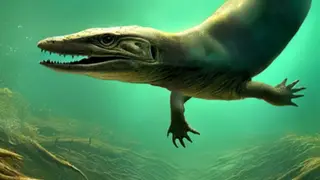
Researchers have identified a previously unknown species of mosasaur, Garamaudo bauciensis, from fossils discovered in southeastern France that date back approximately 84 million years to the Late Cretaceous period. Unlike most mosasaurs which inhabited marine environments, this roughly 2.5-meter-long specimen appears to have been adapted to freshwater lake living. The fossilized remains, including jaw fragments, vertebrae, and limb bones, suggest this early mosasaur represents a transitional form between terrestrial and fully aquatic aquatic reptiles.
Garamaudo bauciensis represents a crucial window into mosasaur evolution during the Late Cretaceous. The specimen's skeletal features—particularly its retained limb structure and firmly attached pelvis—distinguish it from the highly specialized marine mosasaurs that dominated ocean ecosystems. The presence of dense, compact bone throughout the skeleton suggests the animal possessed biological mechanisms for managing buoyancy in its freshwater habitat, enabling it to function as an effective underwater hunter despite retaining more primitive anatomical traits than its marine cousins.
The discovery underscores that freshwater environments of Cretaceous Europe hosted diverse mosasauroid lineages. Fossils from Portugal to Austria demonstrate that these aquatic reptiles successfully colonized inland lakes and river systems alongside their marine relatives. The Bouc-Bel-Air locality's lake ecosystem, with its periodic flooding cycles, preserved Garamaudo bauciensis through unusual taphonomic conditions, offering researchers rare evidence of how early mosasaurs adapted to non-marine settings before the group's eventual extinction.
This discovery may enhance scientific understanding of reptilian adaptation and biodiversity during the Cretaceous, potentially informing broader models of how species diversify across different environments. For paleontology and evolutionary biology education, the specimen illustrates transitional evolutionary pathways—a concept valuable for teaching evolutionary principles. The findings could also influence how researchers interpret fossil-bearing freshwater deposits, potentially leading to reassessment of similar specimens across European collections and deepening knowledge of ancient ecosystem complexity.