Battery Storage Becomes Major Infrastructure Asset as Projects Reach Multi-Gigawatt Scale
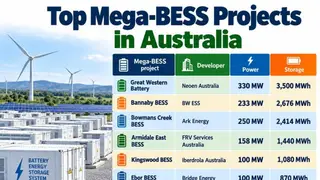
Battery energy storage has transformed from a renewable energy supplement into a standalone infrastructure asset, with major projects in India and Australia now operating at multi-gigawatt-hour scales and attracting billions in investment. Australia's New South Wales region awarded long-term contracts for six long-duration storage projects totaling 12 GWh, each capable of discharging for over eight hours, while India's Adani Green Energy expanded its Khavda installation to 6.63 GWh by October 2026, representing over half of India's operational storage capacity. The shift in project design emphasizes energy duration and grid location alongside power capacity, marking a fundamental change in how battery storage is engineered and valued.
Battery storage technology is transitioning from a secondary grid support tool into a primary energy infrastructure component capable of functioning independently. The architectural design of these installations now prioritizes energy duration—measured in gigawatt-hours—alongside power output, enabling storage systems to discharge electricity continuously for extended periods. This shift enables renewable energy sources like solar and wind to supply power during times when generation is unavailable, addressing one of the key technical challenges limiting renewable energy adoption.
India and Australia are leading this infrastructure evolution through massive installations. Adani Green's rapid expansion at Khavda, scaling from 1.38 GWh to 6.63 GWh within months, demonstrates accelerating deployment capabilities in emerging markets. Australia's awarded contracts emphasize long-discharge specifications, with projects designed to sustain output for eight or more hours, indicating grid operators' recognition that extended energy availability, not just instantaneous power, has become essential for renewable-dependent electricity systems.
Large-scale battery storage deployment could reshape electricity grid reliability and renewable energy economics. Utilities and grid operators may gain flexibility to integrate higher percentages of variable renewable generation while maintaining consistent power supply. Investors and energy companies could access a new asset class with stable, contracted revenue streams. However, realizing these benefits may depend on continued cost reductions, supply chain development, and regulatory frameworks that appropriately value storage services across different time horizons and applications.