Creative Two-Trailer Conversion Delivers Spacious Tiny Home with Character and Off-Grid Capability
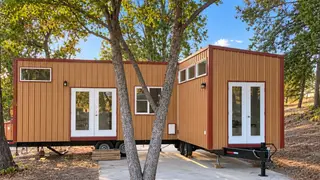
The Templeton tiny house combines two 22-foot trailers into a 352-square-foot dwelling that balances rustic charm with practical living essentials, featuring vaulted ceilings, a private bedroom, walk-in closet, and vintage architectural details. Built in 2017, the home incorporates reclaimed wood throughout, bright cabinetry in the kitchen, and a characterful vintage clawfoot bathtub as a design focal point. The structure includes off-grid capabilities with solar support, making it an autonomous living option for couples seeking simplified, mobile living without sacrificing comfort.
The Templeton represents an innovative approach to mobile housing by utilizing dual trailers as its structural foundation rather than a single unit. This configuration yields 352 square feet of usable interior space while maintaining the mobility advantages of a towable dwelling. The 2017-built structure incorporates practical autonomous systems—inverter technology, battery storage, and solar compatibility—enabling residents to operate independently from conventional utility infrastructure. These features position the home as a viable option for those prioritizing self-sufficiency alongside compact living arrangements.
The design emphasizes aesthetic appeal alongside functionality through salvaged materials and vintage fixtures. The inclusion of reclaimed wood finishes, a period clawfoot bathtub, and carved architectural details creates visual interest within the constrained footprint. Strategic storage solutions—built-in shelving, walk-in closet, and pantry space—address the organizational challenges typical of downsized homes, while vaulted ceilings and multiple windows enhance the perception of spatial openness throughout the interior.
The Templeton's market positioning at $120,000 may influence interest among couples and remote workers evaluating housing cost alternatives. Its off-grid capabilities could appeal to those concerned with utility expenses and environmental impact, potentially expanding the demographic engaged with sustainable living solutions. However, adoption would likely remain limited by transportation logistics, zoning restrictions in many regions, and the specialized financing challenges associated with mobile tiny homes, suggesting impact concentrated primarily within established tiny-house communities rather than mainstream residential markets.