India's Battery Storage Market Expands Through Adani, ACME and IndiGrid Projects Targeting 47 GW by 2032
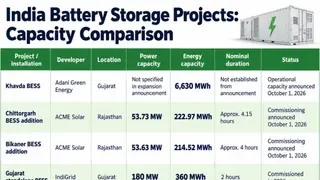
India's battery energy storage sector is growing through large renewable-integrated installations, peak power contracts, and standalone utility facilities, with Adani Green Energy reaching 6.63 GWh at its Khavda location, ACME Solar adding 437.49 MWh in Rajasthan, and IndiGrid deploying 180 MW/360 MWh in Gujarat. National planning targets call for 47.24 GW/236 GWh of battery storage by 2031-32, requiring approximately ₹3.49 lakh crore in investment. The market illustrates diverse business models addressing renewable integration and peak power needs across different financing and contract structures.
India's battery storage sector is diversifying across three distinct operational models. Large renewable energy developers like Adani are integrating storage directly with solar and wind farms to smooth power output, while companies like ACME use batteries to fulfill contractual obligations for reliable electricity delivery during peak demand periods. A third approach, exemplified by IndiGrid's Gujarat facility, operates storage as a standalone asset serving utility companies through competitive procurement.
The national planning framework anticipates substantial growth to meet grid stability needs. Current operational capacity stands near 12.6 GWh, with government projections calling for roughly 19-fold expansion to 236 GWh by 2032. This trajectory requires massive capital deployment estimated at approximately 349 billion USD, reflecting both the technical scale and financial commitment necessary to modernize India's electricity infrastructure for higher renewable penetration.
Battery storage expansion could materially affect India's ability to integrate increasing renewable capacity while maintaining grid reliability and reducing dependence on fossil fuel peaking plants. Utilities, renewable developers, and industrial consumers relying on stable power supply may experience improved electricity availability and cost predictability. The investment scale suggests potential employment and manufacturing opportunities, though actual benefits depend on project execution, technology costs, and whether capacity deployment matches genuine grid requirements rather than exceeding them.