Indo-Pacific Roundup: Green Energy, LNG Finance, Mineral Policy, and Naval Drills
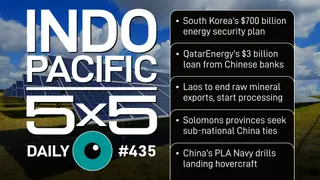
South Korea has outlined a $747 billion green transition plan through 2035, targeting renewable energy expansion, higher electric and hydrogen vehicle sales, and lower industrial emissions. QatarEnergy obtained a $3 billion loan from Chinese banks as its LNG exports remain severely disrupted by conditions around the Strait of Hormuz. The briefing also covers Laos’ plan to stop raw mineral exports and build processing capacity, Solomon Islands provincial efforts to forge ties with China, and Chinese naval hovercraft landing drills.
South Korea’s K-GX plan seeks 100 GW of renewables by 2030 and electric/hydrogen vehicles above 70% of new sales by 2035, while cutting emissions in steel, cement, semiconductors, petrochemicals, and refining. QatarEnergy secured $3 billion from four Chinese banks as Hormuz-related disruptions forced extended LNG force majeure and caused billions in lost sales.
Laos intends to ban raw mineral exports by 2030, requiring processing for gypsum, barite, antimony, cobalt, tungsten, and nickel and domestic smelting/processing for gold, copper, bauxite, and potash. Chinese alumina investors expressed interest, but transport costs, fragmented supply chains, and grid limits remain hurdles. The briefing also covers Solomon Islands provincial China outreach and PLA Navy hovercraft landing drills.
South Korea’s transition could reshape household vehicle choices, industrial employment, and energy costs. Qatar’s LNG disruption may affect Asian and European buyers, while Chinese bank lending could deepen financial ties. Laos’ processing shift could alter mining communities’ jobs and revenues, though infrastructure gaps may slow benefits. Provincial Solomon Islands-China contacts and naval drills may influence local development and regional security perceptions.