Webb Pinpoints Host of Most Distant Fast Radio Burst Yet
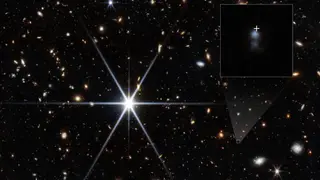
Astronomers detected FRB 20240304B with South Africa's MeerKAT telescope and traced it to a small, metal-poor galaxy that is actively forming stars. The burst traveled more than 10 billion years, making it the most distant FRB known and roughly doubling the previous record. The host's properties support models in which at least some FRBs arise from young magnetars rather than neutron-star mergers.
FRB 20240304B was recorded on 4 March 2024 by the MeerTRAP survey, which uses South Africa's MeerKAT radio array. Its signal crossed over ten billion years, arriving from a time when the cosmos was roughly three billion years old. That distance is about twice the prior record for such bursts.
Webb's NIRCam instrument located the burst's host, a galaxy too faint for the biggest ground-based observatories. The galaxy is compact, lacks many heavy elements, and is making new stars. These traits align with models where some FRBs originate from young, strongly magnetized neutron stars formed in supernovae, rather than from merging neutron stars.
Discoveries like this may strengthen public interest in astronomy and could encourage students toward physics, engineering, and data science. Astronomers and observatory teams may benefit from renewed attention to radio and infrared facilities, while educators could use the record-setting burst to illustrate cosmic distance and uncertainty. Because the cause of FRBs remains unresolved, the finding may also prompt more targeted follow-up observations, though its direct near-term effects on most people's daily lives are likely to remain limited.