Voyager 1 Becomes First Human-Made Object to Reach One Light-Day from Earth
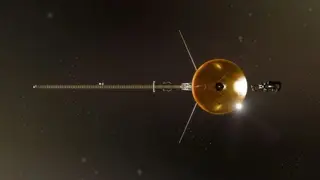
On November 18, 2026, NASA’s Voyager 1 spacecraft became the first human-made object to reach a distance of one light-day from Earth, approximately 16 billion miles away. The milestone was achieved 49 years, 2 months, and 11 days after its launch on September 5, 1977. A one-way signal to the spacecraft now takes exactly 24 hours to reach it, marking a historic achievement in deep space exploration.
On November 18, 2026, NASA’s Voyager 1 spacecraft became the first human-made object to achieve a distance of one light-day from Earth—approximately 16 billion miles (26 billion kilometers)—marking a profound milestone in space exploration. This achievement occurred 49 years, 2 months, and 11 days after its launch on September 5, 1977, from Cape Canaveral’s Launch Complex 41 aboard a Titan IIE Centaur rocket. At this distance, a one-way signal to the spacecraft now takes exactly 24 hours to arrive, underscoring the immense scale of interstellar travel. Voyager 1, which reached interstellar space in 2012—before its twin Voyager 2—was designed for a mission to study the outer planets and their moons, a goal it fulfilled with groundbreaking discoveries. These included the detection of Jupiter’s thin rings and two new moons, the discovery of five new Saturnian moons and a previously unknown ring, and the revelation of Titan’s thick nitrogen-rich atmosphere, hinting at prebiotic chemistry. The spacecraft carries the Voyager Golden Record, a message to potential extraterrestrial civilizations, containing music, greetings in 55 languages, and pulsar maps indicating Earth’s location. Currently, Voyager 1 is en route to Gliese 445, a star in the constellation Ursa Minor, which it will approach within 1.7 light-years in about 40,000 years. Recently, engineers at NASA’s Jet Propulsion Laboratory (JPL) restored communications after a thruster failure triggered a safe-mode shutdown, resolving the issue by switching to lower-power instruments to conserve energy. Voyager 2, now 13.5 billion miles from Earth, is expected to reach one light-day in 2035. The future of both spacecraft remains uncertain, as their power sources degrade and communication becomes increasingly challenging.
Voyager 1’s one-light-day milestone may inspire renewed public interest in deep space exploration and long-duration missions, reinforcing the cultural and scientific value of interstellar probes. While the immediate impact is symbolic—demonstrating humanity’s enduring reach into space—its legacy could influence future mission planning, particularly in extending spacecraft longevity and designing autonomous systems for remote operation. The story may also bolster support for long-term space science funding, especially as NASA prepares to launch new missions like the Nancy Grace Roman Telescope and the Dragonfly mission to Titan. Comparable to the Apollo missions’ role in galvanizing national ambition, Voyager’s journey represents a quiet but enduring testament to human curiosity. However, the broader implications remain speculative: while the public may see it as a triumph of engineering, the scientific community may focus on the diminishing returns of aging probes. What’s next—how long Voyager 1 will remain operational, whether new technologies can revive dormant systems, or how future missions will build on its data—remains unknown. The event could also prompt discussions about interstellar messaging and the ethics of sending signals into space, though no official policy changes are expected.