Voyager 1 Reaches One Light-Day from Earth, Marking a Historic Milestone
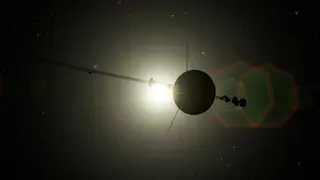
On November 19, 2026, NASA confirmed that Voyager 1 had reached a distance of one light-day—approximately 16 billion miles—from Earth, becoming the farthest human-made object from our planet. The spacecraft, launched in 1977 alongside Voyager 2, has provided groundbreaking insights into Jupiter, Saturn, Uranus, Neptune, and the outer heliosphere. Its continued data transmission informs future missions like Europa Clipper and Dragonfly.
On November 19, 2026, NASA confirmed that Voyager 1 had reached a distance of one light-day—approximately 16 billion miles—from Earth, marking the farthest any human-made object has ever traveled from our planet. The signal confirming this milestone was received at NASA’s Jet Propulsion Laboratory (JPL) at around 5 A.M. EST, though the spacecraft had crossed the threshold the previous day due to the 18-hour communication delay. Launched in 1977 alongside Voyager 2, the twin probes were designed for a brief mission to explore Jupiter, Saturn, Uranus, and Neptune, but have far exceeded their original lifespan. Now in interstellar space, both spacecraft continue to transmit data about the heliosphere’s boundary, measuring cosmic rays, magnetic fields, and plasma waves. Despite their age—nearly 50 years old—Voyager 1 and 2 remain operational, though NASA has recently ceased receiving scientific data from Voyager 1 and has shut down non-essential instruments to conserve power. The mission team, led by project manager Suzanne Dodd and mission manager Kareem Badaruddin, continues to troubleshoot anomalies, driven by a commitment to extend the spacecraft’s operational life. The spacecraft are expected to lose power by 2036, after which they will continue drifting through interstellar space. Voyager 1 carries the Golden Record, a time capsule of Earth’s culture and life, intended for any extraterrestrial intelligence that may one day encounter it.
The milestone of Voyager 1 reaching one light-day from Earth underscores humanity’s enduring reach into space, even as the spacecraft itself nears the end of its operational life. While the immediate impact is symbolic—reinforcing public awe and scientific pride—the broader influence lies in how such long-duration missions shape future exploration. The data collected by Voyager has directly informed current and upcoming missions like Europa Clipper and Dragonfly, demonstrating how past investments in deep space science yield tangible returns decades later. This legacy may inspire renewed public and political support for long-term space initiatives, particularly those focused on planetary science and interstellar probes. Comparable to the Apollo program’s cultural resonance, Voyager’s journey has become a touchstone for scientific ambition. However, the increasing difficulty in maintaining contact with aging spacecraft raises questions about the sustainability of deep space missions and the need for more resilient, autonomous systems. As NASA prepares for future interstellar ambitions, the challenges faced by Voyager—power constraints, signal degradation, and remote diagnostics—may shape how new missions are designed, potentially driving innovation in spacecraft longevity and AI-driven autonomy. What remains to be seen is whether the public and policymakers will view such long-term, high-risk missions as worth the investment, especially as competing priorities emerge.