BepiColombo Successfully Enters Orbit Around Mercury After Eight-Year Journey
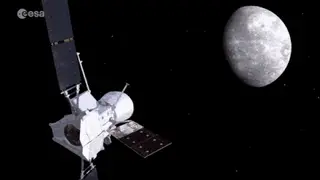
On November 21, 2026, the European Space Agency’s BepiColombo mission successfully placed its two spacecraft into orbit around Mercury, marking the first close-up study of the planet since NASA’s MESSENGER mission ended in 2015. Launched from French Guiana in 2018, the spacecraft used flybys of Earth, Venus, and Mercury itself to slow down and achieve orbit, overcoming the intense gravitational pull of the Sun. The mission aims to study Mercury’s composition, geology, and magnetic field in unprecedented detail.
On November 21, 2026, the European Space Agency’s (ESA) BepiColombo mission successfully executed Mercury Orbit Insertion, placing its two scientific orbiters—the Mercury Planetary Orbiter (MPO) and the Mercury Magnetospheric Orbiter (MMO)—into orbit around Mercury at 12:24 CST (18:24 UTC). This milestone marked the first close-up orbital study of the innermost planet since NASA’s MESSENGER mission concluded in 2015. Launched from Kourou, French Guiana, on October 20, 2018, the spacecraft undertook an eight-year journey using gravity-assist flybys of Earth, Venus, and Mercury itself to gradually slow down and counteract the Sun’s intense gravitational pull. The critical separation of the Mercury Transfer Module from the two orbiters occurred on September 3, 2026, enabling the final orbital insertion. The orbiters will remain together until December 9–10, 2026, before beginning independent science operations in April 2027. The mission aims to address five key scientific mysteries: Mercury’s origin, the presence of water ice in polar regions, whether the planet is geologically active, the cause of its dark surface, and the source of its magnetic field.
The mission is a joint effort between ESA and the Japan Aerospace Exploration Agency (JAXA), combining European and Japanese engineering and scientific expertise. ESA leads the MPO, focused on surface composition and geology, while JAXA leads the MMO, designed to study Mercury’s magnetosphere and its interaction with solar wind. The long journey and complex orbital mechanics reflect prior challenges in reaching Mercury, where the Sun’s gravity makes orbital capture extremely difficult. The success of BepiColombo builds on earlier missions like Mariner 10 and MESSENGER, but with significantly enhanced instrumentation and dual-orbiter capabilities. What remains unresolved is the full timeline of data return and the confirmation of active geological processes or ice deposits. The mission’s findings could reshape planetary science, particularly regarding terrestrial planet formation and evolution in extreme solar environments.
BepiColombo’s successful orbit insertion may inspire renewed public interest in planetary science and space exploration, particularly among younger audiences and students, by demonstrating the complexity and payoff of long-term scientific missions. The mission’s international collaboration between ESA and JAXA could strengthen space diplomacy and foster future joint ventures in deep space exploration. For institutions like NASA, the success of BepiColombo may prompt re-evaluation of its own planetary science priorities, especially in light of the long gap between Mercury missions. The mission’s data could influence future mission planning, such as potential sample return or extended orbital studies. A comparable precedent is the Cassini-Huygens mission to Saturn, which reshaped understanding of icy moons and planetary rings and led to decades of follow-up research. BepiColombo may similarly become a foundational mission for understanding rocky planets near stars. What to watch for next is how quickly the data is analyzed and shared, whether it leads to new models of planetary formation, and whether it spurs new funding or missions to Mercury or other inner solar system bodies.