New Research Strengthens Case for Habitability in Enceladus' Subsurface Ocean
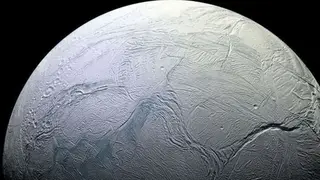
Two peer-reviewed studies led by planetary scientist Frank Postberg from Berlin's Free University present evidence that Saturn's moon Enceladus possesses environmental conditions suitable for microbial life in its subsurface ocean. The first study demonstrates that ocean droplets ejected through ice cracks freeze gradually rather than instantly, allowing organic compounds and salts to concentrate separately in detectable patterns, while the second shows that certain microorganisms could survive in Enceladus' extreme ocean conditions. These findings build on previous Cassini spacecraft data showing hydrothermal activity, organic materials, and salts in the moon's water plumes.
Saturn's moon Enceladus has attracted scientific interest as a potential harbor for extraterrestrial microbes due to its combination of liquid water, chemical nutrients, and energy sources. The moon's south polar region experiences cryovolcanic activity that propels water and ice particles outward, providing researchers with accessible samples of subsurface ocean material that the Cassini spacecraft has analyzed for decades.
The research presented here addresses two major barriers to detecting life if it exists on Enceladus. The first concerns how scientists might recognize biosignatures among the ejected particles—showing that gradual freezing concentrates biological material into identifiable clusters. The second validates that known Earth microorganisms capable of surviving in oxygen-poor, alkaline environments can metabolize under laboratory conditions mimicking Enceladus' actual ocean chemistry.
These findings could influence priorities for future planetary exploration missions by strengthening the scientific rationale for direct sampling missions to Enceladus. If validated by upcoming spacecraft observations, the work may reshape how space agencies allocate resources toward astrobiology research and deep space exploration. The research also engages broader public interest in the search for life beyond Earth, potentially affecting funding support and educational emphasis on planetary science within academic and governmental institutions.