Onshore Wind's Persistent Cost Edge: Understanding Why Cheaper Generation Doesn't Always Mean Better Economics
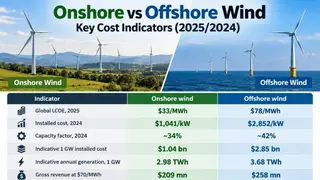
Onshore wind achieved a global weighted-average LCOE of $33/MWh in 2025—less than half the $78/MWh of offshore wind—reflecting its dramatically lower capital requirements and construction complexity. Despite offshore wind's 23 percent electricity generation advantage from stronger, more consistent ocean resources and larger turbines, onshore projects maintain a roughly 174 percent lower installed investment per megawatt. Long-term cost trajectories show onshore LCOE declining 70 percent since 2010 and offshore falling 62 percent, yet the capital intensity gap persists as a fundamental economic constraint for offshore expansion.
The dramatic cost reductions achieved by both wind technologies over the past 15 years reflect significant advances in manufacturing, installation techniques, and supply chain maturation. Onshore wind has benefited from standardized deployment methods and terrestrial infrastructure, while offshore development has progressively adapted maritime engineering solutions. Yet despite offshore wind's capacity to extract greater energy from the same installed nameplate capacity—a 23 percent generation advantage—the fundamental economics remain constrained by the substantially higher expenses associated with marine construction, subsea cabling systems, and specialized vessel requirements.
The gap between cost-per-unit and actual economic value hinges on project-specific conditions. Developers must weigh whether offshore wind's superior generation efficiency justifies the $1.81 billion additional investment required for a 1 GW facility. Regional wind resources, grid location, and financing availability further influence which technology proves economically preferable in any given market.
These cost dynamics could shape energy investment decisions for utilities and governments planning decarbonization strategies. Regions with limited onshore sites may find offshore expansion necessary despite higher capital demands, while areas with accessible land could accelerate onshore deployment to meet climate targets more economically. Project financiers may increasingly scrutinize whether offshore wind's productivity gains justify multibillion-dollar commitments, potentially affecting the pace and geography of global wind capacity additions in the coming decade.