Recent research strengthens case for potential microbial life in Saturn's moon ocean
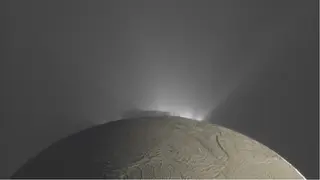
Two new studies examining Saturn's moon Enceladus indicate that conditions in its subsurface saltwater ocean may be more favorable for life than previously believed. One study demonstrates that determining the chemical composition of the ocean's water would be simpler than earlier models suggested, while the other indicates that microbial organisms could survive comfortably in these conditions. These findings reinforce Enceladus's position as a leading candidate for discovering extraterrestrial microbial life within our solar system.
Saturn's moon Enceladus has long intrigued scientists studying the potential for extraterrestrial life. The celestial body harbors a subsurface ocean beneath its icy shell, which researchers have determined contains saltwater and organic compounds. Water vapor periodically erupts from cracks in Enceladus's crust, carrying material from the ocean into space where it can be analyzed by spacecraft instruments.
The two recent studies from German researchers address key questions about habitability and detectability. One investigation reveals that water droplets in the ocean spray freeze more gradually than previously modeled, causing different chemical elements to separate and concentrate in distinct locations. This separation could make it easier for future missions to identify biological signatures. The second study examines whether microbial organisms could physiologically tolerate the moon's ocean conditions, suggesting that certain microbes would find the environment more hospitable than earlier models indicated.
These findings could influence space agency funding priorities and mission planning for solar system exploration. If Enceladus's habitability profile strengthens, it may accelerate efforts to dispatch probes capable of analyzing ocean material more directly. The research may also shape how scientists allocate resources among competing destinations for life-detection missions. Public interest in astrobiology could increase if the scientific consensus increasingly favors Enceladus as a realistic site for discovering microbial life within the coming decades.